
July 2023

Blog Post

IMCS-MIEC PAX ROMANA ELECTS A NEW INTERNATIONAL TEAM FOR THE 2024-2027 ADMINISTRATIVE YEAR

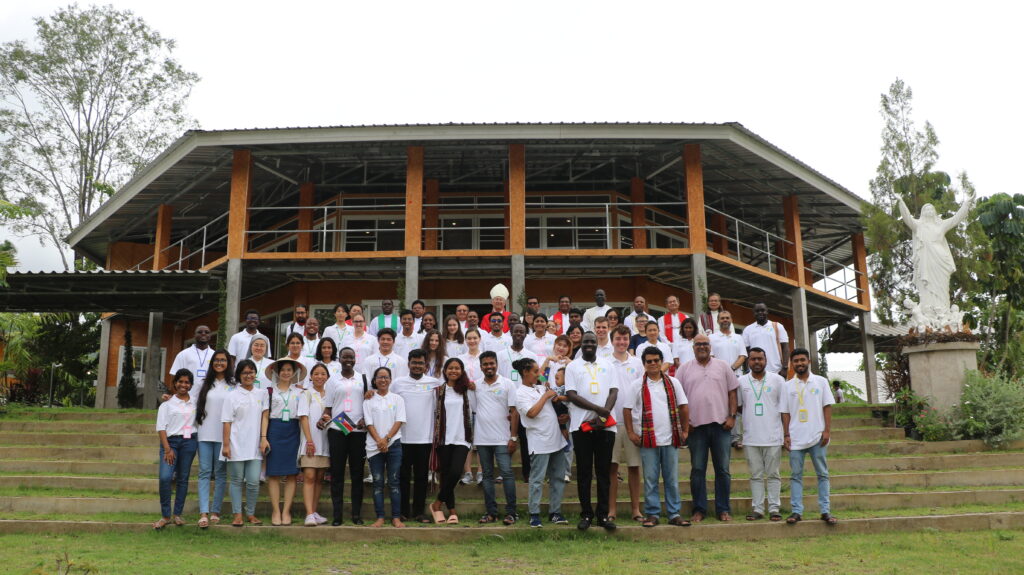
IMCS-MIEC Pax Romana’s leadership has been evolving over the past century with capable leaders seeking to ensure that the Movement continues the mission of ‘Mobilizing students for peace and justice’. Ultimately, the following team was elected to lead the Movement to achieve the objectives of the final plan of action approved by the 2023 delegates of the World Assembly for the next four years. The election took place at the International Youth Training Centre (IYTC) in Chiang Mai, Thailand on July 8, 2023. WILLIAM NOKREK, International President William served as the recent Asia Pacific Regional Coordinator from 2019 to 2022. He is an indigenous person from Garo community of Kaowakuri, Sherpur of Bangladesh.  He is a graduate in Journalism, Communication and Media Studies and has a wider grasp of current realities of youth struggles. As a Journalist, he uses his skills in documentation and visual communication to champion the concerns of young people, especially the marginalized communities like the indigenous people. He has been a member of different movements most of his life and led in different capacities. And for the better part of the last decade, he has been working in IMCS-MIEC Pax Romana specifically as a Human rights activist, towards protection of rights of indigenous peoples and Marginalised Communities in Bangladesh and Asia Pacific region; towards Student empowerment, Youth Rights and Meaningful Participation. Emphatically quoting Pope Francis, as he also called on young people to be “agents of social change”, referencing the Papal message to mark the Pax Romana Centenary Celebration. In addition, William said “I’ve learned and felt that human rights, indigenous peoples’ rights and environmental justice have not just been my passion and work but now it’s become my fundamental commitment. I believe that power is in these young people.” FASIKA LACHORE LABA, International Secretary-General Fasika served as the recent Pan Africa Regional Coordinator from 2019 to 2022. He is an Ethiopian and has BSc in Information Technology, Msc in Software Engineering and Pursuing Master Degree in Development Studies at Catholic University of Eastern African.. With a profound dedication to advancing social justice and an unwavering commitment to serving others, he believes that his extensive skills and experiences will help him lead the Movement to achieve its objectives during the Administrative Year. He has been responsible for East, West, and South Africa through correspondence, planning and managing annual projects aimed at empowering young people. And fundraising for country-specific programs as well as managing the finances and the staff of the secretariat. As a member of the Movement for over a decade, he has engaged in policy dialogues on various platforms for campaigns, advocacy, formation. And the outcome the Coordination working together is the development of the Child Safeguarding and Welfare Policy for the organization involved in human rights advocacy and monitoring the development of strategic campaigns. Part of his mission is managing resources, developing and growing partnerships and engaging stakeholders by promoting peace, social justice, and empowering young people through an organized entrepreneurial skills and development training for youth participation and sustenance. FR JOJO M. FUNG SJ, International Chaplain Fr Jojo is a Jesuit Priest from Malaysia. He served in various capacities within the Asia Pacific Regional Coordination. Currently, he is also an Assistant Professor at the Loyola School of Theology in Manila, Philippines.  Having collaborated with the 2020-2023 International Team, and working with the Chaplains and lay animators at the global, Latin American, Pan Africa and Asia Pacific and European levels, Fr Jojo is motivated to continue accompanying a few more generations of chaplains and laywomen/men animators based on this unshakable conviction: “IMCS is as strong as the animators & Chaplains are formed”. With his experiences of spearheading the Chaplains, Lay Animators and Elders Commission, he see the need for continuity as there are lots of works to be done in the next four years (2024-2027) to lay the foundation for a strong IMCS-MIEC in the next 10 years if the movement is to be sustained in the next 100 years till 2121, especially coordinating with regional chaplains onwards. He stated clearly his mission to accompany the new team in building up and sustaining the training programs for the formation of committed leadership of our tertiary students throughout the world at the training and formation centres being established by IMCS-MIEC Pax Romana (namely IYTC, PRCC and the future centres). As the Team’s Accompanier, he seeks to support to strengthen and coordinate closer parternship with civil society organizations, UN agencies, officials in the Dicasteries in Vatican, FABC and local Bishop Conferences to continue promoting IMCS-MIEC Pax Romana’s mission. They will be working with outgoing International Team and the current International Coordinating Team members; Ravi Tissera Warnakulasooriya – International President (Outgoing) Victor Kweku Ayertey, International Secretary-General (Outgoing) In a nutshell, the significance of the paths we thread towards addressing the needs of the coming years and our impact on the next generations guides us as a Student, Church and an Educational Movement as well as an International Organization.
Statements

Final Declaration on “Global Climate Emergency: Capacity building of tertiary students to be advocates for environmental, social, cultural, political and economic justice”

World Assembly, July 3-9, 2023 1. Introduction: This Climate Emergency Declaration of July 2023 by the International Movement of Catholic Students (IMCS) Pax Romana is first of all, a global pragmatic step by the Movement in support of Pope Francis’s encyclical of Laudato Si’. Secondly, it is an action response to the pronouncement made on 12 December 2020 by the United Nations Secretary-General, António Guterres asking governments to declare a climate emergency in their countries until neutrality is attained. Finally, this is a deliberately informed step taken by an international body of approximately 5 million young catholic tertiary students – opinion leaders in their countries, continents, and eventually internationally. Pope Francis in his address to the United Nations in 2015 said that young people remind us that the earth is not a possession to be squandered, but an inheritance to be handed down. IMCS Pax Romana agrees with Pope Francis in this statement and Laudato Si’ that as young people, we are faced not with two separate crises, one environmental and the other social, but rather with one complex crisis, both social and environmental. To this effect, each and every one of us on mother earth has an obligation to make deliberate choices to care for the common home and in important cases such as this one, come together as an international body to make declarations that allow young people to target specific environmental stewardship actions. This Declaration has been ascended to by the delegates of IMCS Pax Romana World Assembly who gathered in Chiang Mai, Thailand from 03 – 09 July 2023 on Global Climate Emergency at the newly constructed International Youth Training Centre. The World Assembly brought 103 participants (76 in-person and 27 online) from 33 different countries in Europe, Africa, Asia Pacific, Latin America and North America. Representing about 53.5% males and 46.5% females; this comprised Catholic Students Leaders, Observers, Facilitators, Interpreters as well as Chaplains & the Religious. 2. Key Issues: The study sessions included workshops, presentations and panel discussions, during which the participants were conveyed important information regarding the Global Climate Emergency, advocacy and partnership building for climate action, and mechanisms of other organizations such as the UN. During the study sessions by various resource persons from different backgrounds, fields, organisations and countries, many issues relevant to the climate emergency were pointed out and highlighted. Some of the issues identified are as follows: Rising global temperature: The Earth’s average temperature has been going up because of the release of greenhouse gases, mainly carbon dioxide, into the atmosphere. This results in different outcomes like heat waves, droughts, lost crops, drinking water shortage, increasing the risk of wildfires and the melting of ice caps. Extreme weather events: As the Earth’s temperatures increase, glaciers and ice sheets melt, resulting in the rise of sea levels. This poses a danger to coastal communities, low-lying islands, and ecosystems that are vulnerable. It can also lead to an increase in coastal erosion, intrusion of saltwater, and occurrences of flooding. The rising of ocean levels also causes conflicts among communities due to the problems associated with migration and land ownership.  Loss of biodiversity: Climate change disrupts ecosystems and puts biodiversity at risk. Many species are unable to adapt to rapidly changing conditions, resulting in habitat loss, species extinction, and imbalances in ecosystems. Food Sovereignty: Food and water security are also affected by climate change. It impacts agricultural productivity, leading to crop failures, reduced yields, and higher food prices. Additionally, water availability is affected, with some regions experiencing droughts and others facing increased rainfall and flooding, both of which can disrupt water supplies. Health problems: Furthermore, climate change contributes to the spread of diseases, such as vector-borne diseases like malaria and dengue fever. Changing temperatures and rainfall patterns create more favourable conditions for disease vectors. Heatwaves and air pollution also pose risks to human health. What one may consider as the smallest or most insignificant are the same groups of people that get the worst impact of issues relating to climate change, especially as they are the ones who interact closely with nature.  During many instances throughout the study sessions, the facilitators stressed the importance of local communities on climate change action. Through generations of close interactions with the environment, indigenous peoples safeguard an estimated 80% of the world’s remaining biodiversity. Just as the smallest of communities are the most affected by the issues that were discussed, together, the global community has an opportunity to reorient the way it interacts with nature and build resilience for all through collaborating with and learning from indigenous peoples, the stewards of nature.  1. Relocation and loss of land: Innate communities and those living in destitution frequently depend on normal assets for their jobs. Climate change has led to the loss of land and assets due to rising ocean levels, expanded flooding, and desertification, constraining these communities to migrate. 2. Food and water insecurity: Climate change disturbs rural homes and diminishes crop yields, driving to nourishment deficiencies and expanded nutrition-related healthcare costs. Indigenous communities and those underneath the poverty line are especially defenceless to these impacts, as they regularly depend on subsistence cultivating and have restricted access to alternative food sources. 3. Health dangers: Climate change increments the spread of illnesses, such as water borne illnesses and vector-borne illnesses, which can excessively influence indigenous peoples and those living in poverty. Constrained access to healthcare and insufficient framework exacerbates this issue. 4. Cultural loss: Indigenous peoples have deep connections to their ancestral land, traditional knowledge and practices, which are often threatened by climate change. Loss of land, natural resources, and traditional knowledge can lead to the erosion of cultural identity and practices. 5. Limited resources for adaptation: Indigenous peoples and those living in poverty regularly have constrained monetary assets and access to technology, making it troublesome for them to adjust to the impacts of climate change. This compounds their defencelessness to climate-related dangers and challenges. The need for immediate action to address climate change issues and mitigate

Useful Link

Where We Are

IMCS-MIEC Pax Romana Africa
IMCS Pax Romana Asian Pacific
IMCS Pax Romana North America
MIEC-JECI Latin America
JECI-MIEC Europe
IMCS Pax Romana Middle East
©2026. IMCS Pax Romana. All Rights Reserved.
Scroll to Top